


In fantasy cricket, no decision moves your score more than the choice of captain and vice-captain. On many apps the captain earns double points and the vice-captain one and a half times, so the same eleven players can produce very different totals depending on who wears the armband. This guide explains why the choice matters so much, which factors to weigh, how contest size changes the right pick and the common mistakes that cost points. It is about making better decisions, not about guaranteed results: one dropped catch can still change any match.
Quick answer
- On many apps the captain scores 2x points and the vice-captain 1.5x.
- Choose players with the most ways and chances to score: top-order batters, all-rounders and bowlers in key overs.
- Wait for the confirmed playing XI and toss before locking your picks.
- In small contests, pick the most likely high scorer; in large ones, a less popular captain can separate your team.
- Check the points table on your app, because scoring rules differ.
Why the captain matters so much
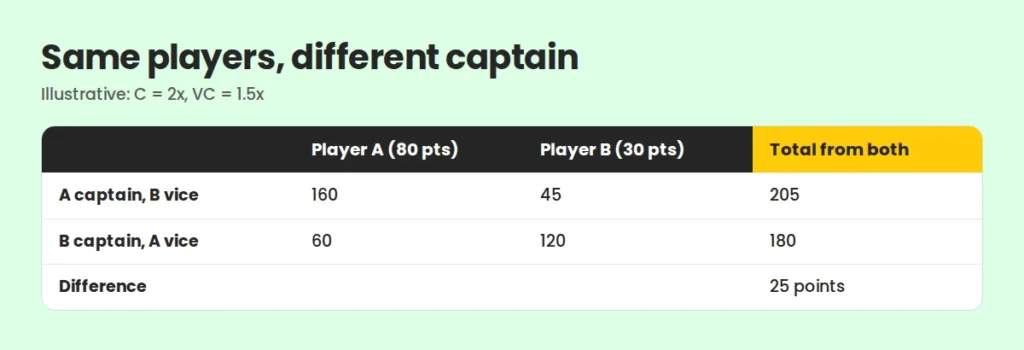
The maths is simple. Making a player captain adds a full extra copy of his points to your total. Making a player vice-captain adds an extra half. If your captain scores 80 base points, he adds 80 more. If your vice-captain scores 30, he adds 15 more.
That is why two teams with identical players can finish far apart on a leaderboard. The rest of your team builds the base score; the captain and vice-captain decide where you finish.
A worked example
Say Player A scores 80 points and Player B scores 30. With A as captain and B as vice-captain, the pair gives you 160 + 45 = 205 points. Swap them and you get 60 + 120 = 180. Same players, same match, 25 points apart. In a close contest, that gap can be hundreds of places.
What to weigh before choosing
1. The confirmed playing XI
Never lock a captain before the line-ups are announced, usually around the toss. A star who is rested or injured scores zero, and doubling zero is still zero.
2. Role: more ways to score
All-rounders can earn points with both bat and ball, and often in the field too. A player who bats in the top five and bowls four overs has two chances to have a good day.
3. Workload and batting position
Openers and top-order batters face the most balls, so they have the most time to score. In T20s, a batter’s strike rate matters because points often reward boundaries and fast scoring. For bowlers, look at who bowls in the powerplay and at the death, when wickets tend to fall.
4. Conditions and venue
Flat pitches with short boundaries favour batters. Pitches that turn or seam favour bowlers. Dew in evening matches can make bowling harder in the second innings. Recent scores at the same venue give a useful guide.
5. Matchups and form
Consider how a batter has fared against the opposition’s main bowlers, and how a bowler fares against left- or right-handers. Recent form matters, but over a few innings it can be noise, so weigh it alongside role and conditions.
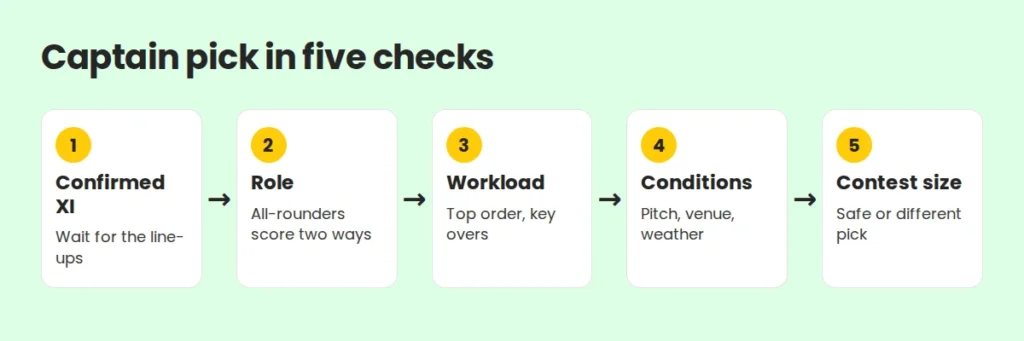
Safe pick or different pick?
The right captain depends on the contest you enter.
Small contests and head-to-heads. You only need to beat a few teams. Pick the player most likely to score highly, even if most people choose him too.
Large contests with many entries. Many teams will share the same popular captain. If he scores well, you have not gained ground; if a less-picked player has the big day, teams that captained him jump ahead. A different captain carries more risk and more room to move up.
A balanced approach many players use: one popular choice and one different choice across captain and vice-captain.
Format makes a difference
- T20: Fewer balls each, so top-order batters and all-rounders who bowl four overs are the usual captain picks.
- ODI: More overs give anchoring batters time to build big scores, and front-line bowlers bowl up to ten overs.
- Test (where offered): Scores are spread over days; batters who bat long and wicket-taking bowlers on helpful pitches stand out.
Mistakes that cost points
- Locking a captain before the confirmed XI.
- Picking on reputation rather than role and conditions.
- Captaining a lower-order batter who may not face many balls.
- Using the same captain in every team in a large contest.
- Ignoring the app’s points table, such as bonus points for wickets or penalties for ducks.
- Changing picks at the last second on a hunch without a reason.
A five-minute routine before the deadline
- Read the confirmed XI and toss result.
- Shortlist three captain options: top-order batter, all-rounder, key bowler.
- Check the pitch and venue notes.
- Decide your contest strategy: safe or different.
- Lock captain and vice-captain, then do not change them without a clear reason.
Picking an app to play on
Copied download pages are common, and people who search Vikrant Exchange or vikrantexch sometimes reach them, so use official addresses only. On Winfix (often written as Win Fix), as on any platform, read the full points table for each game before you join. Wfix Fun is another platform from the same group. To compare fantasy platforms, see our guide to choosing the best fantasy cricket app in India.
FAQ
How many points does a fantasy cricket captain get?
On many apps the captain earns 2x points and the vice-captain 1.5x. Check the points table of your app, as rules can differ.
Should I pick a batter or a bowler as captain?
Top-order batters and all-rounders are the most common choices because they have more chances to score. A bowler can be a strong pick on a helpful pitch or when he bowls in key overs.
When should I choose my captain and vice-captain?
After the playing XI is confirmed, usually around the toss, and before the contest deadline.
Is it better to pick a popular captain?
In small contests, yes, usually. In large contests, a less-picked captain can help your team stand out if he scores well, but it carries more risk.
Can a good captain pick guarantee a win?
No. Captaincy decisions improve your chances over many contests, but match events such as rain, injuries or a single dropped catch can change any result.
Before you play
Betting and real-money games are for adults aged 18 and over. Set a budget you can afford to lose, and use deposit limits and time-outs if you play more than you planned. India’s Promotion and Regulation of Online Gaming Act, 2025 and its 2026 rules affect real-money online games, and state laws differ, so check the laws that apply where you live.