

A ₹1,000 bet on India at 1.80 shows a potential return of ₹1,800, and plenty of first-timers read that as ₹1,800 profit. It is not. ₹1,000 of it is your own stake coming back, so the profit if India win is ₹800.
Reading cricket betting odds correctly starts with that one point, and the rest follows from the same number. A decimal price tells you three things: what you get back, what chance the price implies, and how much margin is built into the market. This guide works through one match, India against Australia in an ODI, with India at 1.80 and Australia at 2.10. These prices are illustrative, but the maths is the same on any match you look at.
Working out the payout
Decimal odds show the total you get back for every ₹1 staked if the bet wins, stake included. Two formulas cover every case:
Return = stake × odds, and profit = stake × (odds minus 1).
On our match:
- ₹1,000 on India at 1.80 returns ₹1,800. Profit: ₹800.
- ₹1,000 on Australia at 2.10 returns ₹2,100. Profit: ₹1,100.
- ₹500 on India at 1.80 returns ₹900. Profit: ₹400.
The bet slip usually shows the return, not the profit. Before you confirm, subtract the stake in your head so you know what you are actually playing for.
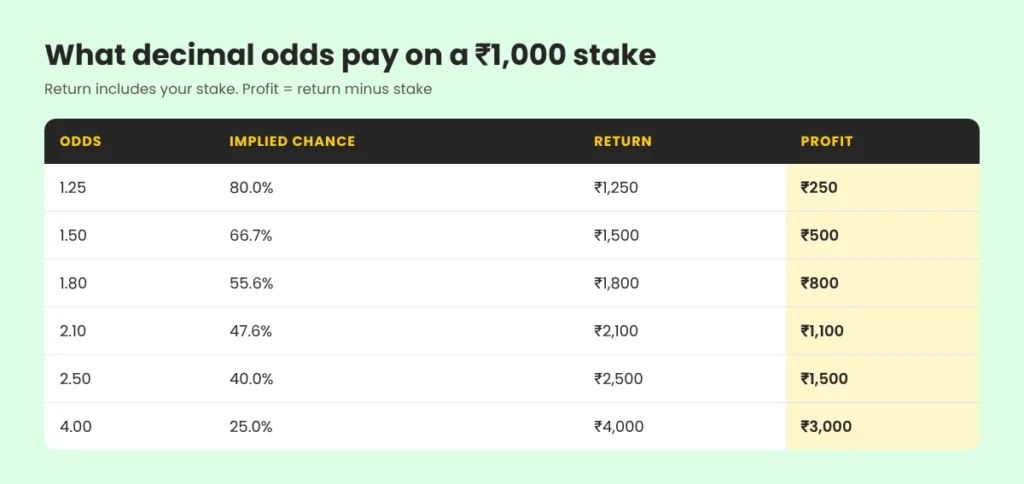
Notice how the payout shrinks as odds get closer to 1. At 1.25, you risk ₹1,000 to make ₹250, so one losing bet wipes out the profit from four winning ones.
Turning odds into a chance
Divide 1 by the decimal odds and you get the chance the price implies. The general explanation of odds covers the maths behind this in more depth.
- India at 1.80: 1 ÷ 1.80 = 0.556, or 55.6%.
- Australia at 2.10: 1 ÷ 2.10 = 0.476, or 47.6%.
So a price of 1.80 says India win this match about 55.6% of the time. That is the most useful conversion in cricket betting, because it lets you test a price against your own view. If you honestly think India’s chance is closer to 50%, then 1.80 is a poor price for you, however strong the side looks on paper. Your own estimate can be wrong too, of course, which is why a fixed budget matters more than any single opinion.
The margin: why the chances add up to more than 100%
Only one of the two teams can win (leave ties and no-results aside for now), so in a fair market the two chances would add up to exactly 100%. Add our numbers together and they do not.
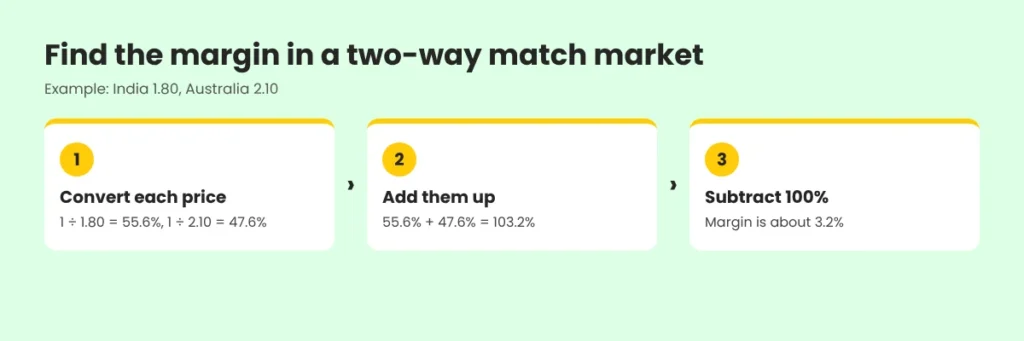
55.6% plus 47.6% comes to 103.2%. The extra 3.2% is the margin, the edge the site has built into the market by setting each price slightly shorter than a fair price would be.
To see what that costs you, work out the fair prices. Multiply each price by the total (1.032): India’s fair price is about 1.857 and Australia’s about 2.167. On a ₹1,000 winning bet on India, the fair price would return about ₹1,857 against the ₹1,800 you actually get. That ₹57 gap is the price of the margin on that one bet.
A lower margin means more of every rupee staked comes back to bettors over time. Comparing margins on the same match across two or three sites is one of the simplest checks you can run.
Comparing two prices on the same team
Say one site offers India at 1.80 and another at 1.85.
- At 1.80, ₹1,000 wins ₹800 profit, and the implied chance is 55.6%.
- At 1.85, ₹1,000 wins ₹850 profit, and the implied chance is 54.1%.
That is ₹50 more on every winning ₹1,000 bet, for the same outcome on the field. Over 20 winning bets of that size it adds up to ₹1,000. Differences of a few points between sites are common, so check more than one price before you decide.
Fractional odds and Indian-style rates
Some previews still quote fractional odds such as 4/5 or 6/4. To turn them into decimal, divide the first number by the second and add 1: 4/5 becomes 0.8 plus 1, which is 1.80. And 6/4 becomes 1.5 plus 1, which is 2.50.
Indian bookmaker-style markets often show rates such as 80 or 150, meaning ₹80 or ₹150 profit per ₹100 staked. Divide by 100 and add 1 to get decimal odds.
| Fractional | Rate per ₹100 | Decimal | Implied chance |
|---|---|---|---|
| 1/2 | 50 | 1.50 | 66.7% |
| 4/5 | 80 | 1.80 | 55.6% |
| Evens (1/1) | 100 | 2.00 | 50.0% |
| 6/4 | 150 | 2.50 | 40.0% |
| 3/1 | 300 | 4.00 | 25.0% |
Formats vary between sites and markets, and the same number can mean different things on different screens. Read how a market displays its prices before you place anything.
How the price moves during the match
Odds change with every event that shifts the chances: the toss, an early wicket, a long partnership, dew in the second innings, or rain that brings a revised target into play. If India lose three quick wickets, their 1.80 can drift to 2.60 or longer within a few overs.
Once your bet is accepted, the price on your slip is the one that counts; later moves do not change it. If the price changes while your slip is still open, you should be shown the new price and asked to confirm again. Read the slip each time, because a fast-moving live market can change the number between your tap and the confirmation.
Try it yourself
In a T20 match, Team A are 1.60 and Team B are 2.40. You put ₹750 on Team B.
- What is your return if Team B win?
- What is your profit?
- What chance does 2.40 imply?
- What is the margin in this market?
Answers: ₹750 × 2.40 = ₹1,800 return. ₹1,800 minus ₹750 = ₹1,050 profit. 1 ÷ 2.40 = 41.7%. For the margin, 1 ÷ 1.60 = 62.5%, and 62.5% plus 41.7% = 104.2%, so the margin is about 4.2%, higher than our India and Australia example.
Where to put this into practice
Run the 1 ÷ odds check on both teams before every bet, wherever you play. On Winfix or any other site, do the return and profit sums yourself before you confirm the slip. The group behind it is Vikrant Exchange, which some people search for as Vikranth Exchange. Look-alike pages use both names, so check that the address bar shows an official address (winfix.com, winfix.live, winfix.fun, wfix.vip, ve567.live or vikrant247.com) before you log in.
Our list of the top online cricket betting sites in India covers what to compare beyond the headline price, and the guide to online cricket betting in India puts odds alongside markets, formats and bankroll basics.
FAQ
What does it mean when odds drift or shorten?
Drifting means the price is getting bigger, so the market thinks that team’s chance has fallen. Shortening means the price is getting smaller because the market rates the team’s chance higher.
Do higher odds mean better value?
No. Higher odds pay more because the outcome is less likely. Value depends on whether the implied chance is lower than the real chance, and that is hard to judge.
What happens to my bet if the match is a tie or no result?
It depends on the market rules. Some markets settle ties one way, others void the bet and return stakes. Read the rules for that market before you place a bet.
Before you play
Betting and real-money games are for adults aged 18 and over. Set a budget you can afford to lose, and use deposit limits and time-outs if you play more than you planned. India’s Promotion and Regulation of Online Gaming Act, 2025 and its 2026 rules affect real-money online games, and state laws differ, so check the laws that apply where you live.