

Arjun deposits ₹10,000 on a site that keeps his balance in US dollars. He places no bets, changes his mind a week later and withdraws the lot. ₹9,506 lands back in his bank. Nobody charged him a fee he could see, and he did not lose a single bet, yet ₹494 has gone.
That gap is the whole case for online cricket betting sites in Indian rupees. When your balance, stakes and winnings stay in rupees from deposit to withdrawal, nothing is converted, so nothing leaks out along the way. This guide works through Arjun’s numbers, shows the formula so you can test your own card or account, and ends with the checks to run on any INR betting site.
Where the ₹494 went
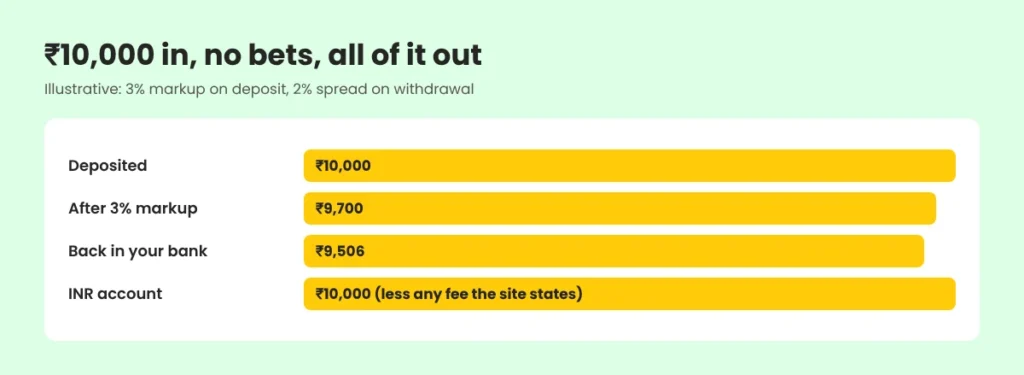
Two separate costs hit Arjun’s money, one on the way in and one on the way out.
On the way in. His bank or card issuer turned his rupees into dollars at a rate worse than the mid-market rate, plus a foreign currency markup. In this illustrative case the combined cost is 3%, so his ₹10,000 bought only ₹9,700 worth of dollars.
On the way out. When he withdrew, the dollars were turned back into rupees, and the provider again used a rate in its own favour. The gap between the rate at which a provider buys a currency and the rate at which it sells is called the bid–ask spread. Take 2% here, and ₹9,700 becomes ₹9,506.
The formula is:
Money back = deposit × (1 minus cost in) × (1 minus cost out)
For Arjun: ₹10,000 × 0.97 × 0.98 = ₹9,506.
You might expect 3% plus 2% to make ₹500. It comes to ₹494 because the second cost is taken from the smaller ₹9,700, not the original ₹10,000. Either way, he paid about 5% for a round trip that did nothing.
These percentages are examples, not quotes. Your own bank’s fee schedule shows the markup it charges on foreign-currency payments, and that is the number to put in the formula.
How the cost changes with the rates
Here is the same ₹10,000 round trip, no bets placed, at a few different cost levels:
| Cost in | Cost out | Back in your bank | Lost to conversion |
|---|---|---|---|
| 1% | 1% | ₹9,801 | ₹199 |
| 2% | 2% | ₹9,604 | ₹396 |
| 3% | 2% | ₹9,506 | ₹494 |
| 3.5% | 3.5% | ₹9,312.25 | ₹687.75 |
| INR account | None | ₹10,000 | ₹0 (less any fee the site states) |
Even the gentlest row costs about ₹200 every time ₹10,000 goes in and comes back out. Over a season of deposits and withdrawals, that adds up to real money spent on nothing but currency.
Add the exchange rate on top
Fees are only half of it. Arjun’s balance is in dollars, so its rupee value moves every day.
Say the rate is ₹85 to the dollar when he deposits. His ₹9,700 after the markup buys about $114. If the rupee strengthens to ₹83 by the time he withdraws, and the 2% spread still applies, he gets back about ₹9,280. If it weakens to ₹87, he gets about ₹9,730.
Same deposit, no bets, and the result ranges from roughly ₹9,280 to ₹9,730 depending on a rate he cannot control. That is the real problem for a budget. With a rupee balance, ₹10,000 stays ₹10,000.
What happens to your winnings
Decimal odds work the same in any currency. A ₹500 stake at odds of 1.80 returns ₹900, which is ₹400 profit.
In an INR account, ₹900 is the amount you can withdraw, less any fee the site itself states. In a foreign-currency account, that ₹900 worth of dollars passes through the 2% spread on the way out, so ₹882 reaches your bank. The ₹18 lost is 4.5% of your ₹400 profit. Conversion costs bite harder on profit than on the stake, because they are charged on the whole amount withdrawn.
Payments and budgets in one currency
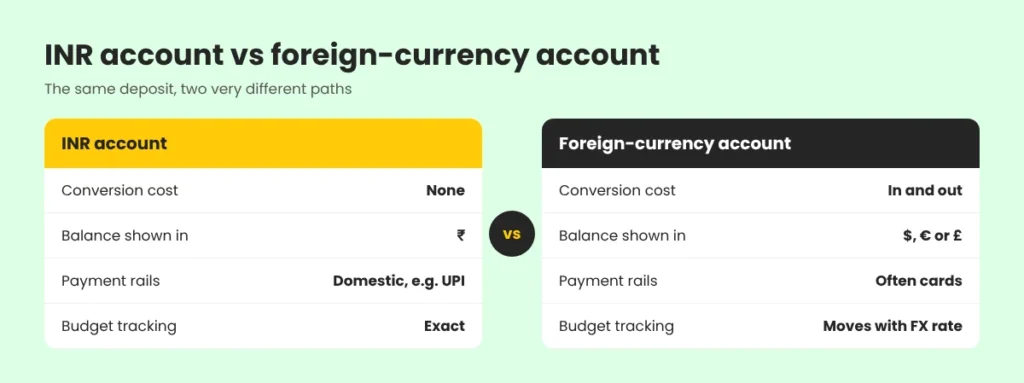
UPI and IMPS move rupees between Indian bank accounts, quickly and at any hour. A site that holds your balance in rupees can work with those domestic rails. Sites that run accounts in other currencies often depend on international cards or intermediaries instead, and some Indian banks decline those payments. Check the payment page of any site for the methods it offers before you register.
Budgeting is simpler too. If your betting budget is ₹3,000 a month, a rupee wallet shows exactly how much of it is left. A dollar wallet forces you to convert in your head, and a rate move can make a loss look smaller or a win look bigger than it is. Deposit limits and loss limits are also easier to set and stick to when they are written in rupees.
Try it yourself
Priya deposits ₹8,000 into a euro account. Her card adds 2.5% on the way in and the withdrawal spread is 1.5%. She places no bets and withdraws everything. How much reaches her bank, and how much has she lost?
Answer: ₹8,000 × 0.975 = ₹7,800. Then ₹7,800 × 0.985 = ₹7,683. She has lost ₹317 to conversion alone. In an INR account she would have her ₹8,000 back, less any fee the site states.
What to check on INR betting sites
Before you deposit anywhere, run these checks:
- The wallet balance, stake box and bet slip returns all show ₹.
- Minimum deposit and minimum withdrawal are written in rupees.
- The payment page lists domestic options that pay out to Indian bank accounts.
- The payment terms mention no currency conversion fee.
- Withdrawal limits are stated in rupees, per request and per day.
Check the address as well. People search for names such as Vikranth Exchange or vikranthexch to find the group’s sites, and look-alike pages copy those names, so start from an official address: winfix.com, winfix.live, winfix.fun, wfix.vip, ve567.live or vikrant247.com.
When you look at Winfix, you will find the rupee details above on its deposit and withdrawal pages, and the same checks apply on our other platforms. Our page on the best betting platform for Indian users covers the other features worth comparing beyond currency.
FAQ
Can a rupee account still charge fees?
Yes. A site may state its own deposit or withdrawal fees, and your bank may have its own charges. An INR account removes the conversion cost, not every possible fee, so read the payment terms.
Where do I find my bank’s foreign currency markup?
It is in your card or account fee schedule, usually on the bank’s website or in the account documents. Many banks also show the markup as a separate line on the statement after a foreign-currency payment.
What is the mid-market rate?
It is the midpoint between the buying and selling rates for a currency, the figure you see in most rate checkers. Banks and payment providers rarely give you that rate; the difference is part of what you pay.
Before you play
Betting and real-money games are for adults aged 18 and over. Set a budget you can afford to lose, and use deposit limits and time-outs if you play more than you planned. India’s Promotion and Regulation of Online Gaming Act, 2025 and its 2026 rules affect real-money online games, and state laws differ, so check the laws that apply where you live.