


A message lands in a Telegram group at 9 pm: “Dragon has won six in a row. Tiger is next. Join for daily signals.” Within minutes, dozens of members put ₹500 each on Tiger. Some win, some lose, and the admin posts only the screenshots of the winners.
If you play the Dragon Tiger game online in India, you will see messages like this every week. This guide sets out the rules, works out the real cost of each bet in rupees, and takes the most common beliefs one at a time. Rules vary by table, so the numbers below use the most common setup: an eight-deck shoe, with half your Dragon or Tiger stake lost when the round is a tie.
How a round works
The online game, Dragon versus Tiger, is about as simple as card games get.
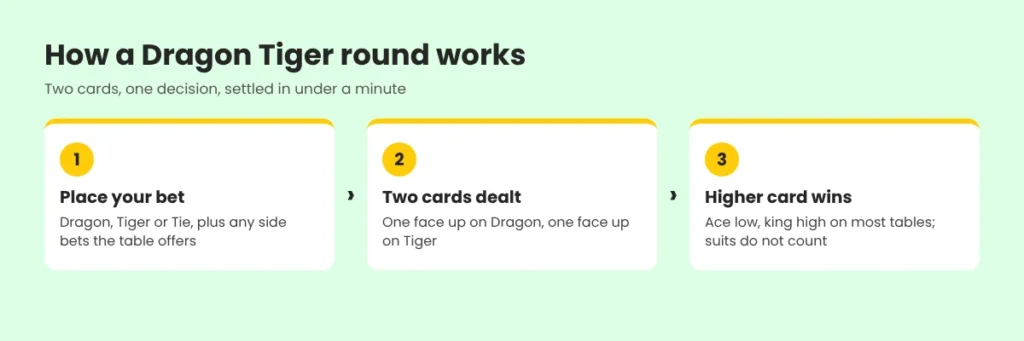
- You bet on Dragon, Tiger or Tie, plus any side bets the table offers.
- The dealer places one card face up on the Dragon spot and one on the Tiger spot.
- The higher card wins. On most tables the ace is lowest and the king highest, and suits do not count for the main bets.
There is no third card and nothing to decide once the cards are out. A round is often over in under a minute, which matters more than most players think.
Myth: “Dragon and Tiger are 50-50, so the game is fair”
Dragon and Tiger do have the same chance as each other. Neither has a 50% chance, though, because ties happen.
An eight-deck shoe holds 416 cards, with 32 of each rank. Whatever card lands on Dragon, 31 of the remaining 415 cards share its rank. So a tie comes up 31 ÷ 415 of the time, about 7.47%. That leaves about 46.27% for Dragon and 46.27% for Tiger.
Take a ₹100 bet on Dragon with the half-stake rule:
- 46.27% of the time Dragon wins and you collect ₹100 profit.
- 46.27% of the time Tiger wins and you lose ₹100.
- 7.47% of the time it is a tie and you lose ₹50.
The wins and losses cancel out. The ties cost you 7.47% × ₹50, about ₹3.73 for every ₹100 you bet. That is the house edge on Dragon or Tiger: 3.73%. On a table that takes your full stake on a tie, it doubles to about 7.47%, so the tie rule is the first thing to read.
Myth: “Tie pays the most, so it is the smart bet”
Tie pays more because it rarely lands, and the payout varies by table. That one number changes the cost more than anything else in the game.
| Bet | Usual payout | Chance of winning (8 decks) | House edge |
|---|---|---|---|
| Dragon or Tiger, half stake lost on a tie | 1:1 | 46.27% | 3.73% |
| Dragon or Tiger, full stake lost on a tie | 1:1 | 46.27% | 7.47% |
| Tie | 8:1 | 7.47% | 32.77% |
| Tie | 11:1 | 7.47% | 10.36% |
| Suited tie (same rank and suit) | 50:1 | 1.69% | 13.98% |
Here is the Tie at 8:1 worked through. A winning ₹100 Tie bet returns ₹900: your ₹100 back plus ₹800. That happens 7.47% of the time, so the average return is 0.0747 × ₹900, about ₹67.23 for every ₹100 staked. You lose about ₹32.77 per ₹100 over time. At 11:1 the average return is 0.0747 × ₹1,200, about ₹89.64, so the cost falls to about ₹10.36.
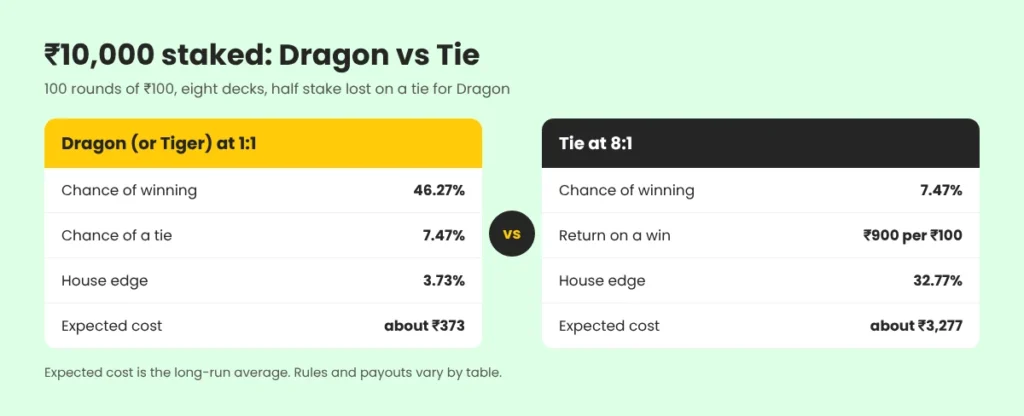
Even at its best payout, the Tie costs nearly three times as much as Dragon or Tiger.
Myth: “Dragon has won five in a row, so Tiger is due”
This belief has a name: the gambler’s fallacy. The cards do not know who won last time. Both spots are dealt from the same shoe in the same way, so whatever cards have already gone, Dragon and Tiger still have exactly the same chance on the next deal.
Streaks feel meaningful, but they are normal. With each side winning about 46% of rounds, a run of five or more wins for the same side turns up in roughly nine out of ten sessions of 100 rounds. Seeing one tells you nothing about the next card.
Myth: “The scoreboard shows a pattern you can follow”
Live tables show result boards, often called roads, that colour-code past rounds. They are a neat record of what happened. They are not a forecast. A board that looks like it is “zig-zagging” or “dragging” is a drawing of random results, and the next round is dealt the same way regardless of its shape.
Myth: “Signal groups and prediction apps can see the next card”
No app can see a card before it is dealt. Groups and apps that sell predictions earn from fees, referral links or deposits made through their own links, whether you win or lose. Warning signs include paying to join a “VIP” signal channel, being asked for an OTP, being asked to share your screen, and APK files sent in chats.
Copycat pages also borrow familiar names. People who search for Vikranth Exchange, or type the shorter vikranthexch, sometimes reach look-alike sites, so stick to official addresses you have typed or bookmarked yourself, such as winfix.com, winfix.live, winfix.fun, wfix.vip, ve567.live and vikrant247.com. winfix.one and ve777.in are no longer in use.
Myth: “Doubling up after a loss wins it back”
Doubling after each loss looks safe on paper: ₹100, then ₹200, ₹400, ₹800, ₹1,600, ₹3,200. Six losing rounds in a row means ₹6,300 gone while chasing a ₹100 profit. A Dragon bet fails to win about 53.73% of the time, so six in a row happens about 2.4% of the time, roughly once in every 42 attempts. Over an evening of fast rounds, that is not rare. Table maximums can also stop the doubling before it pays off, and every doubled bet still carries the same 3.73% edge.
What to do instead
- Read the rules panel first. Check the tie rule for Dragon and Tiger bets, the Tie payout, and the minimum and maximum stakes.
- Stick to Dragon or Tiger if you want the lowest cost per round. Leave the Tie for tables that pay 11:1, and treat even that as the expensive option.
- Count rounds, not just rupees. At 60 rounds an hour, ₹100 a round is ₹6,000 staked per hour, with an expected cost of about ₹224 on Dragon or Tiger.
- Fix your stake and session budget before you start, and never raise the stake to recover a loss.
- Use official addresses. Start from Winfix and check the address bar before you log in. Wfix Fun works in the mobile or desktop browser, so there is no app to install for it.
If you are comparing platforms for a dragon vs tiger online game alongside other tables, our guide to choosing the best online casino and sports betting platform lists what to check.
FAQ
Does the number of decks change the odds?
Slightly. With six decks a tie comes up about 7.40% of the time and the Dragon or Tiger edge is about 3.70% under the half-stake rule. With a single deck, ties fall to about 5.88% and the edge to about 2.94%. The Tie payout matters far more than the deck count.
Can I bet on Dragon and Tiger at the same time?
You can on many tables, but it only adds cost. With ₹100 on each, one bet wins and the other loses when there is no tie, so you break even. On a tie you lose ₹50 on each, ₹100 in total. Over time that costs the same 3.73% of everything you stake.
Are live dealer and digital versions the same game?
The rules are usually the same. Live tables deal from a physical shoe, while digital versions use a random number generator, and some reshuffle a virtual shoe every round. Whichever dragon versus tiger online game you open, check the rules panel for the deck count and tie rule.
Before you play
Betting and real-money games are for adults aged 18 and over. Set a budget you can afford to lose, and use deposit limits and time-outs if you play more than you planned. India’s Promotion and Regulation of Online Gaming Act, 2025 and its 2026 rules affect real-money online games, and state laws differ, so check the laws that apply where you live.