


Almost every sports betting app in India offers accumulators, often called accas, parlays or multi-bets. You combine several selections into one bet, and the odds multiply, so a small stake can return a large amount. The catch is that every selection has to win, and the bookmaker’s margin multiplies along with the odds. This guide explains how accumulator odds are calculated, why the margin compounds, what happens when a leg is void, and how to use multi-bets without letting them eat your budget.
Quick answer
- An accumulator combines two or more selections; all must win for the bet to pay.
- The odds of each leg are multiplied together to give the total odds.
- Each leg’s margin multiplies too, so expected returns fall as legs are added.
- A void leg is usually removed, and the bet continues on the remaining legs.
- Keep acca stakes small; treat them as entertainment, not a plan.
What an accumulator is
An accumulator is one bet made of several selections, called legs. A double has two legs, a treble three, and anything larger is usually called an accumulator. The legs can be from different matches and often different sports: a cricket match winner, a football result and a tennis winner can sit in one bet, as long as the site allows that combination.
If every leg wins, the bet pays at the combined odds. If any leg loses, the whole bet loses.
How the odds multiply
To find the total odds, multiply the decimal odds of every leg.
Worked example:
- Leg 1: India to win at 1.80
- Leg 2: a football team to win at 1.90
- Leg 3: a tennis player to win at 2.00
Total odds = 1.80 × 1.90 × 2.00 = 6.84. A ₹100 stake returns ₹684 if all three win, for a profit of ₹584. As singles, the same three bets would need ₹300 in stakes.
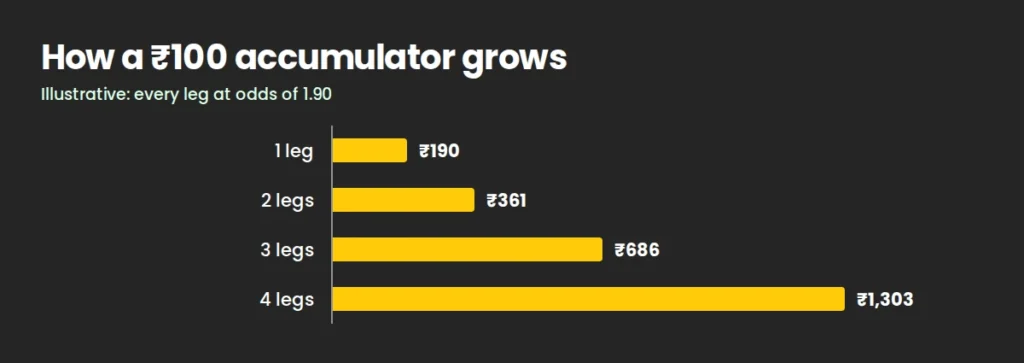
The chance of winning shrinks just as fast. If each leg had a 50% chance, a three-leg acca would have a 12.5% chance (0.5 × 0.5 × 0.5), and a five-leg acca about 3%.
Why the margin compounds
Every price includes a margin for the site. On a single bet, the margin might cost you a few percent of your stake over time. In an accumulator, you pay that margin on every leg, and the costs multiply.
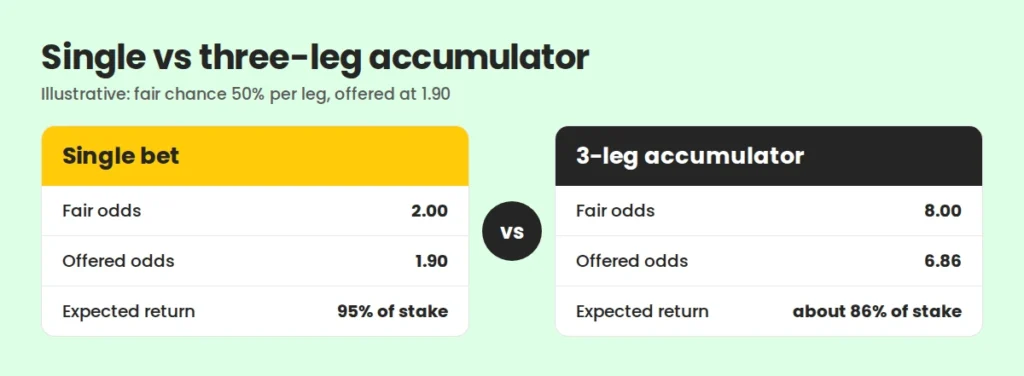
In the illustration, each leg is a true 50% chance offered at 1.90 instead of the fair 2.00. As a single, the expected return is 95% of your stake. In a three-leg acca, the offered odds are 6.86 against fair odds of 8.00, so the expected return falls to about 86%. Add more legs and it falls further. The mathematics of bookmaking explains how this margin, or overround, is built into every price.
Void legs, dead heats and cash-out
- Void legs. If a match is abandoned or a bet is voided, most sites treat that leg as if it had odds of 1.00. The acca continues on the remaining legs at lower total odds.
- Dead heats. If a leg ends in a dead heat, it is settled at reduced odds and the acca carries on at the new total.
- Cash-out. Some apps let you settle an acca early for a set amount. The offer usually includes a margin of its own.
Check the rules on each of these before you place a multi-bet.
Related selections are often blocked
Many sites will not let you combine two selections from the same match when they depend on each other, such as a team to win and that team’s top batter to score a fifty. Where a site does allow it, the combination may be offered as a “bet builder” with its own price rather than straight multiplied odds.
Accumulators across sports
Accas are common in football, because a weekend of Premier League fixtures offers many matches with similar kick-off times. In cricket, multi-bets often combine several match results across a day of league cricket. Mixing sports works the same way, but check how each sport settles: a rain-affected cricket match and a postponed football match may be treated differently.
How to use accumulators sensibly
- Cap the share of your budget that goes into accas, for example a fixed small amount per week.
- Keep legs few. Doubles and trebles lose less to the margin than ten-leg bets.
- Only add legs you would bet as singles. A weak leg added “for the odds” lowers your chance more than it raises the price.
- Record results separately from singles, so you can see what accas (parlay) cost you over time.
Mistakes to avoid
- Adding legs to chase a big payout. Each one cuts the chance of winning.
- Treating short-priced legs as “safe”. A 1.20 leg still loses about one time in six on fair odds.
- Ignoring void and cash-out rules. They change what you are paid.
- Rebuilding the same acca after a loss. That is chasing, not planning.
Choosing an app for multi-bets
The best sports betting app in India for multi-bets is one that shows the combined odds clearly and explains its void and cash-out rules before you place the bet. Sports betting apps in India also attract copycats: people searching names like Vikrant Exchange or Vikranth Exchange can end up on look-alike pages, so use the official address. Winfix shows a bet slip you should check before confirming any multi-bet. VE777 offers a separate site from the same group. For what to compare when choosing an app, see our guide to online sports betting apps in India.
FAQ
How are accumulator odds calculated?
Multiply the decimal odds of every leg. Three legs at 1.80, 1.90 and 2.00 give total odds of 6.84.
What happens if one leg of my accumulator is void?
Most sites treat a void leg as odds of 1.00 and settle the bet on the remaining legs. Check the site’s rules.
Are accumulators a good bet?
They offer large returns for small stakes, but every leg must win and the margin multiplies with each leg. Over time, accas usually return less than singles.
Which sports betting apps in India offer accumulators?
Most do, across cricket, football and tennis. Compare how clearly each app shows combined odds and explains void, dead-heat and cash-out rules.
What is the difference between a parlay and an accumulator?
None. Parlay is the common American term; accumulator or acca is the British and Indian term for the same bet.
Before you play
Betting and real-money games are for adults aged 18 and over. Set a budget you can afford to lose, and use deposit limits and time-outs if you play more than you planned. India’s Promotion and Regulation of Online Gaming Act, 2025 and its 2026 rules affect real-money online games, and state laws differ, so check the laws that apply where you live.