

Aviator is a crash game: a small plane takes off, a multiplier climbs from 1.00x, and you have to cash out before the plane flies away. Rounds last seconds, which makes it one of the most played instant games online. If you are searching for the best Aviator game in India, the useful question is not which site has a winning trick, but how the multiplier is decided and what the maths means for your stake. This guide explains one round step by step, what RTP and “provably fair” mean, the real chance of reaching common cash-out targets, and the myths to ignore.
Quick answer
- You bet before take-off and cash out at any point while the multiplier climbs.
- If the plane flies away first, you lose that stake.
- The crash point of each round is random and set before the round starts.
- Higher cash-out targets pay more but are reached less often.
- No app, signal group or pattern can predict the next crash point.
How an Aviator round works
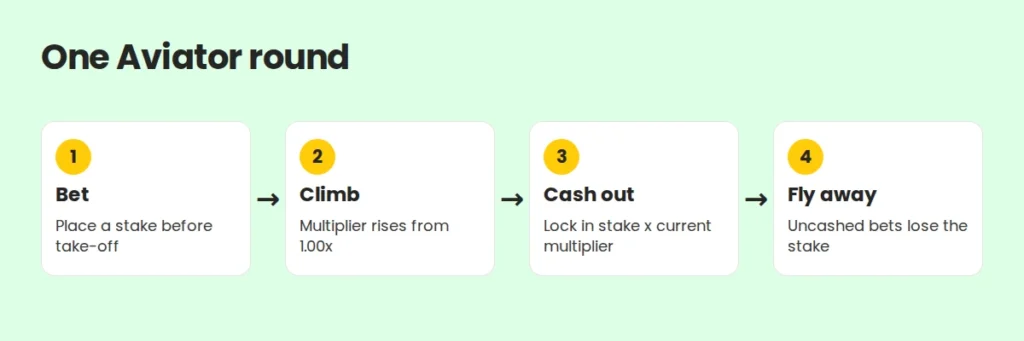
Every round follows the same four steps.
- Betting window. Before take-off you place a stake. Most versions let you place two separate bets in the same round.
- Take-off. The multiplier starts at 1.00x and rises the longer the plane stays in the air.
- Cash out. Press cash out at any moment and you receive your stake multiplied by the figure on screen. A ₹100 stake cashed at 1.80x returns ₹180.
- Fly away. At the crash point the round ends. Any bet not yet cashed out loses.
Auto cash-out lets you set a target, such as 1.50x, before the round. The game cashes out for you if the multiplier reaches it.
Some rounds end almost immediately, at or near 1.00x. Those rounds are part of the game’s design, and they happen to everyone at the table at once.
Where the crash point comes from
The crash point is decided before the plane takes off. It is not reacting to how many players are betting or when they cash out.
The original Aviator uses a “provably fair” system. The result of each round is generated from a server seed combined with seeds from players in that round, and the game publishes a hash you can check after the round. In plain terms, it lets you confirm the result was fixed in advance and not changed mid-flight. It does not let anyone see the next result before it happens.
RTP: what the game pays back over time
Return to player (RTP) is the share of all money staked that a game pays back over a very large number of rounds. The original Aviator states an RTP of 97% in its rules panel, which means a house edge of about 3%. Over a long run of play, a player can expect to lose about ₹3 of every ₹100 staked, whatever cash-out style they use. Copies and clones may use different figures, so read the rules panel of the version you open. The Wikipedia article on return to player explains the idea in more detail.
RTP says nothing about a single session. Short runs swing a lot in both directions.
What RTP means for cash-out targets
In a crash game with a 97% RTP, the chance that a round reaches a given multiplier is roughly 0.97 divided by that multiplier. That gives a quick way to see the trade-off.
| Cash-out target | Approximate chance of reaching it | Return on ₹100 if reached |
|---|---|---|
| 1.20x | about 81% | ₹120 |
| 1.50x | about 65% | ₹150 |
| 2.00x | about 49% | ₹200 |
| 5.00x | about 19% | ₹500 |
| 10.00x | about 10% | ₹1,000 |
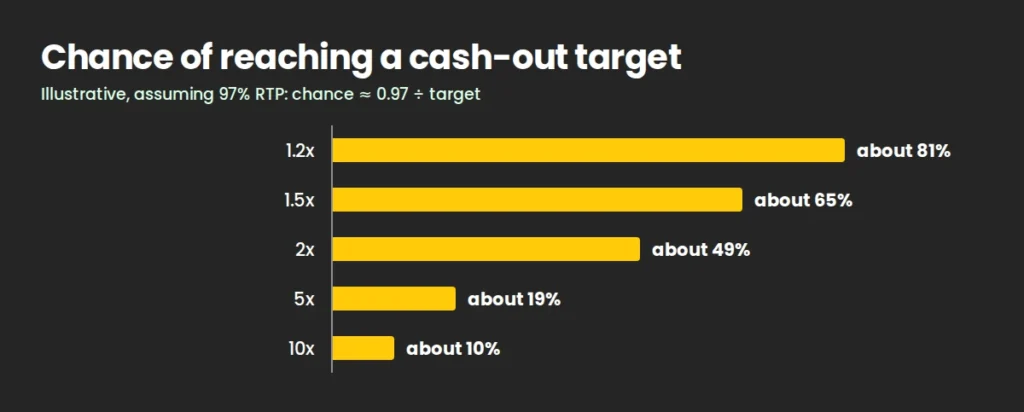
These are illustrative figures based on that formula. Multiply each chance by the payout and you get about 97 in every row. That is the point: a low target wins often but small, a high target wins rarely but large, and every target has the same built-in cost.
Myths that cost players money
- “A big multiplier is due.” Each round is independent. Ten low rounds in a row do not make the next one higher.
- “Prediction apps and signal groups can see the next round.” They cannot. Many of them exist to collect deposits, OTPs or app permissions.
- “Doubling after a loss recovers it.” Doubling (the Martingale) grows stakes fast and runs into table limits and empty budgets.
- “Two bets cancel out the risk.” Two bets are two stakes, each with the same house edge.
Choosing the best Aviator game in India
The game itself is the same maths wherever you play it, so the choice is about the platform. Look for the official version of the game with a visible rules panel and RTP, clear minimum and maximum bets, fast withdrawals and deposit limits you can set yourself. People who search for names such as Vikrant Exchange or Vikranth Exchange sometimes end up on copycat pages, so type the official address and check it before you log in.
Winfix shows each game’s rules inside the game window, which is where to confirm the RTP and bet limits. Wfix VIP is another platform from the same group if you want to compare game lobbies. Our guide to online casino and sports betting sites covers the wider checks worth making.
Playing with a plan
Decide before you start how much you will spend in the session and how long you will play. Pick one cash-out style and keep stakes the same, rather than changing them after every round. Rounds are quick, so a session can run through a budget faster than a cricket match; a timer helps.
FAQ
How does the Aviator game work?
You place a bet before take-off, then a multiplier rises from 1.00x. Cash out before the plane flies away to receive your stake times the multiplier; if it flies away first, the stake is lost.
Can the Aviator crash point be predicted?
No. The crash point is generated at random before each round starts. Apps, bots and signal groups that claim to predict it cannot do so.
What is the RTP of Aviator?
The original Aviator lists an RTP of 97% in its rules, a house edge of about 3%. Clones may differ, so check the rules panel in the game you play.
What is a safe cash-out multiplier in Aviator?
No target is safe. Lower targets are reached more often but pay less; the expected return is about the same at every target because of the house edge.
What is auto cash-out in Aviator?
Auto cash-out is a setting that cashes your bet automatically when the multiplier reaches a target you choose before the round starts.
Before you play
Betting and real-money games are for adults aged 18 and over. Set a budget you can afford to lose, and use deposit limits and time-outs if you play more than you planned. India’s Promotion and Regulation of Online Gaming Act, 2025 and its 2026 rules affect real-money online games, and state laws differ, so check the laws that apply where you live.