


A Ludo betting app turns the familiar board game into a real-money contest: players pay an entry fee, play a match, and the winner takes a prize after the platform’s fee. The rules look like the game you played as a child, but real-money versions often use timers, points and shorter formats, and those changes affect how much skill matters. This guide explains the standard rules, the formats you will see in Ludo online betting, how entry fees and “odds” really work, and the skill tips that make a difference over many games.
Quick answer
- Each player has four tokens and moves them around the board by dice roll; the goal is to bring them home.
- Real-money apps often use quick, timed or points-based formats instead of the full classic game.
- The platform keeps a share of entry fees, so you must win more than half your one-on-one games just to break even.
- Dice rolls are chance; token choice, safe squares and captures are where skill comes in.
- Set a budget per session and stop when it is gone.
The basic rules of Ludo
Ludo is played by two to four players, each with four tokens of one colour. Players take turns rolling one die and moving a token that many squares clockwise around the board. Ludo is a simplified version of the Indian game Pachisi; this page on the history and traditional rules of Ludo gives the background.
The most common rules on apps are:
- Opening. In classic rules, you need a six to move a token out of the base. Some formats start tokens already on the board.
- Extra turns. Rolling a six usually gives another roll. Three sixes in a row often cancels the turn.
- Capturing. Landing exactly on an opponent’s token sends it back to their base, and on many apps earns an extra roll.
- Safe squares. Starred or coloured squares where tokens cannot be captured.
- Home column. Each colour has a final column; tokens must reach the end, often with an exact roll.
Check the rules screen of the app you use, because small differences, such as whether you need a six to start, change the strategy.
Real-money Ludo formats
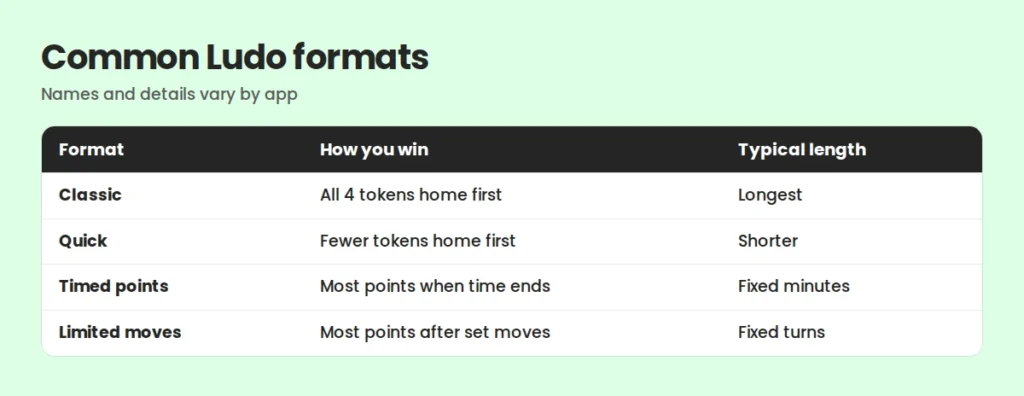
Classic. All four tokens must reach home. Longest and the most room for skill to show.
Quick. Only one or two tokens need to finish. Shorter, with more weight on the dice.
Timed points. Players score points for squares moved and captures, and lose points when captured. Whoever leads when the timer ends wins.
Limited moves. Each player gets a fixed number of turns, then points decide the winner.
Shorter formats mean more matches per hour, which matters for your budget as much as your results.
How entry fees, prizes and “odds” work
There are no bookmaker odds in Ludo. Searches for Ludo betting odds are really asking about your chance of winning against what you pay.
Worked example (illustrative): two players each pay ₹100 entry. The prize is ₹180, and the platform keeps ₹20 as its fee. To break even over many games, you need to win 100 ÷ 180, or about 55.6% of matches. Against an opponent of equal skill, you would expect to win about 50%, so the fee means you lose money over time unless you are clearly better than your opponents.
In four-player games, only one player usually wins, so equal-skill players win about 25% of matches, and the prize must cover three losses plus the fee.
Where skill comes in
The die is random: each number from one to six has a 1 in 6 chance on every roll. What you control is which token to move. Over many games, good choices add up.
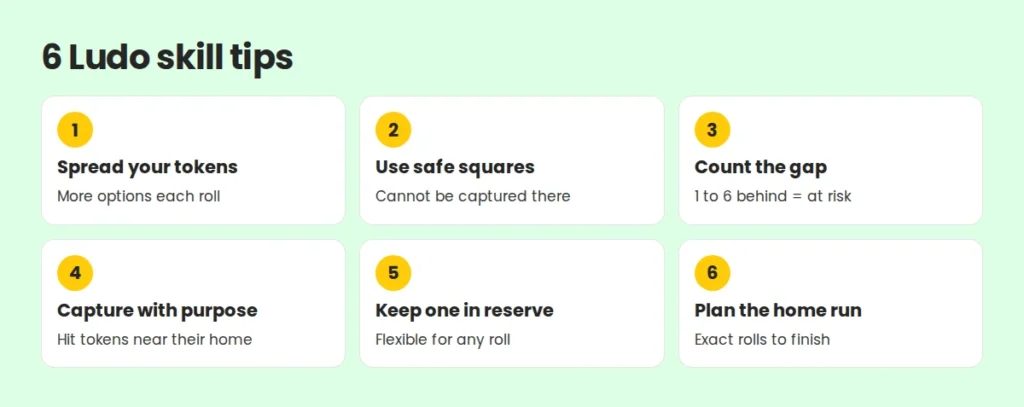
- Spread your tokens. Two or three tokens on the board give you more options for each roll.
- Use safe squares. Park tokens on safe squares when opponents are close behind.
- Count the gap. A token one to six squares in front of an opponent can be captured with a single roll. Moving it further ahead or onto a safe square cuts the risk.
- Capture with purpose. Hitting a token that has travelled far costs your opponent more than hitting one just out of base.
- Keep one token flexible. A token that can use any roll stops you being forced into a bad move.
- Plan the home run. If an exact roll is needed to finish, get tokens close early so you have several chances.
In timed formats, speed matters too: slow moves waste turns, and points for captures can decide close games.
Common mistakes in Ludo online betting
- Playing many quick games to “win it back” after a loss.
- Joining higher entry tables after a winning streak.
- Ignoring the platform fee when judging results.
- Playing tired or distracted in timed formats.
- Downloading a Ludo app from a forwarded link instead of the official site.
Fair play checks
Before you deposit, look for a published rules page, a clear statement on how dice rolls are generated, a policy on bots and collusion, and deposit limits. If an opponent seems to play impossibly fast or perfectly, use the app’s report option.
Finding the official app
Download pages are often copied, and people who search Vikrant Exchange or vikrantexch can reach look-alike sites, so start from the official address. If you play board and card games on Winfix (often written as Win Fix), check each game’s rules screen first, as formats differ. Wfix VIP is another platform from the same group. Our guide to top mobile games in India covers other real-money game types and how they compare.
FAQ
How does a Ludo betting app work?
Players pay an entry fee, play a Ludo match against each other, and the winner receives a prize from the pooled fees after the platform takes its share.
Is real-money Ludo a game of skill or chance?
Both. The dice are random, but choosing which token to move, using safe squares and timing captures are decisions that affect results over many games.
What are Ludo betting odds?
There are no bookmaker odds. Your real “odds” are your chance of winning against the entry fee and prize. With a 10% fee in one-on-one games, you need to win about 55.6% of matches to break even.
Which Ludo format is best for beginners?
Classic games give more time to think. Quick and timed formats are faster and put more pressure on decisions, so start slow and with low entry fees.
How can I keep Ludo online betting under control?
Set a session budget and time limit, use deposit limits, and stop after a set number of losses instead of chasing.
Before you play
Betting and real-money games are for adults aged 18 and over. Set a budget you can afford to lose, and use deposit limits and time-outs if you play more than you planned. India’s Promotion and Regulation of Online Gaming Act, 2025 and its 2026 rules affect real-money online games, and state laws differ, so check the laws that apply where you live.